Tuesday, August 20, 2024

 Chronological Development of Fragmentation Analysis Methods


Over the decades, fragmentation analysis models have evolved significantly, driven by technological advancements and the growing need for more accurate and efficient methods. This article traces the chronological development of fragmentation analysis models, highlighting key milestones that have shaped the field.

1. Early Theoretical Models (1950s-1970s)

The foundation of fragmentation analysis began with theoretical models aimed at predicting rock breakage based on empirical observations and basic physics.

1950s: Early models focused on understanding the mechanics of rock breakage during blasting. Researchers like L. M. Griffith introduced the concept of rock fracture mechanics, which provided a theoretical basis for predicting crack propagation in rock under stress.

1963: C.F. Konya and E.J. Walter developed the first significant mathematical model, which related explosive energy to the size distribution of blasted rock. This model, known as the Kuz-Ram model (named after the Kuznetsov equation and Rosin-Rammler distribution), laid the groundwork for future fragmentation analysis.

1970s: Further refinements were made to the Kuz-Ram model, with adjustments to account for factors such as rock type, explosive properties, and blast geometry. However, these early models were limited by the lack of sophisticated computational tools and relied heavily on empirical data.


2. Introduction of Image Analysis Techniques (1980s-1990s)

The advent of digital image processing in the 1980s marked a significant leap forward in fragmentation analysis.

1986: The first commercial software for image-based fragmentation analysis, WipFrag, was introduced by WipWare Inc. WipFrag utilized digital images of blast muck piles to analyze particle size distribution, offering a more accurate and practical alternative to manual sieving methods.

1990s: The 1990s saw widespread adoption of image analysis software in the mining industry. These tools allowed for real-time fragmentation analysis, enabling operators to assess blast performance on-site and make immediate adjustments to subsequent blasts.

3. Advances in Computational Modeling (2000s)

The turn of the millennium brought further advancements in computational power and modeling techniques, leading to more sophisticated fragmentation analysis models.

4. Integration of Artificial Intelligence and Machine Learning (2010s-Present)

The most recent developments in fragmentation analysis have been driven by the integration of artificial intelligence (AI) and machine learning (ML) techniques.


WipWare's pioneering image analysis software revolutionized blasting assessment by offering real-time, accurate fragmentation analysis, reducing reliance on manual methods, and enabling immediate adjustments to improve blast outcomes.


Visit wipware.com now to learn about the development from 1986 till date

Friday, November 17, 2023

ROCK AND MINING REVIEW

 The Earth consist of various sphere including be the hydrosphere (water), lithosphere (land), the atmosphere (space region), the hemisphere and many other sphere. The most valuable among them all that supports the manufacturing and innovation is the lithosphere.
The land host in place millions of Mineral components. Mineral as we know it to be is a solid inorganic  substance, generally formed by inorganic process with crystalize structure and consistent of definite chemical composition. Almost everything around us now consist of one or more mineral. How is minerals formed?
The journey of minerals begin from rock formation, to understand the origination of mineral we have to know a bit more about rock and their formation process. Because, rock is an accommodation of various mineral, and the breaking down of this rock through weathering process results in the detachment of minerals into separate grains.
Teaching the formation of rock in this slide will assist us in learning about how the geological formation of the subject matter "mineral" comes in place.
Generally, the Earth is consisting of three Layers, the core, the mantle and the crust.
The core is the innermost part of the Earth and the mantle is the solid and the heaviest part of the Earth consisting of liquified rock called magma. Magma is the rock which had been transformed into liquid state understand high temperature and hydrothermal pressure. The journey of all the solid rock we see around us begins with the liquid state right there in the mantle.
As time goes on, the mantle compartment holding the magma also known as magma chamber undergo metaphorical relief which bring about the migration of the magma through available active fracture (cracks) in the chamber. The chamber under high pressure and temperature with the state of it flexibility support the continuous upflow of the rock magma  towards the surface. During this migration, the magma (liquid rock) consist of various mineral components dissolved in it. The solidification of the magma depends strictly on the reduction of temperature and pressure. As the magma migrates from higher temperature region to lower temperature region it viscosity increases.
 Viscosity for the sake of those who are hearing that for the first time is the degree of ease migration of a liquid. It also refer to the ability of liquid layers to slide on each other under an applied shear stress which support the liquid migration. The change in phase process Begin as the temperature and pressure reduces. The rock at it liquid state moves towards the Earth surface through existing fractures as I have explained in the previous slide. The result of the outpouring of liquid magma to the surface is called volcano. The solidification of the molten magma (or lava) at the surface support one type of rock formation called *Igneous Rock*
Igneous Rock is know to be fire rock according to the Greek translation of Igneo. This rock is formed when the magma cools and solidifies. The cooling process produces two Major types of Igneous Rock which depends on the rate of cooling. The volcanic and the plutonic Igneous Rock. The words sound strange? Let us learn about them together. Remember I said the igneous rock is just one of the type of rock and is the primary source of all rock on Earth surface and subsurface. Also, I mentioned that the cooling process of the hot magma (rock in liquid state) depends on the surrounding temperature and pressure condition. The migration of the magma sometimes stopped at the subsurface without getting to the surface, at this stage the rock formation from such is called *The plutonic Igneous Rock* they experience slow cooling process due to the high temperature nature. The implication of the slow cooling is that, the elemental components in the magma have sufficient time to react with each other and to form various mineral components. In the cooling process also, the Mineral components have the time to conglumerate into ore.
 Plutonic rock are known to have coarse grains (phaneritic texture) example of this rock type is Granitic rock (Granite) and pegmatite.
Another rock type is the volcanic Igneous Rock, which unlike plutonic cools rapidly. They are as a result of the surface flow of magma cooling rapidly under lower temperature and pressure. Such rock type is characterize by fine grains. Example is obsidian and pumice.
Understanding the origination of Igneous Rock as the primary source of rock, other two types of rock, the metamorphic rock and the sedimentary rock type are formed from the altering of the physical, structure and components of the primary Rock (igneous rock). Because of limited time I will not be giving detail explanation to the other two rock type. Nevertheless, metamorphic rock is formed by the structural and physical change in existing rock under high temperature effect. Sometimes due to reactivation of passive volcanic conduit or through inflow of new magma into existing rock.
Basically, the science understanding of metamorphic rock formation is the contact and regional process. These two processes are define to be the main original transformation process that bring about metamorphic rock. The word metamorphic rock is from the process called metamorphism. The word meta means Heat and the word morphism means change. Change as a result of heat is what brings about metamorphic rock. Taking a look at rock cycle, we tend to appreciate metamorphic rock formation better.bthe effect of heat on both Igneous and sedimentary rock brings about metamorphic rock.
Example of metamorphic rock is marble which is formed from limestone, gneiss from granite rock.
Finally the sedimentary rock is formed from both metamorphic and igneous rock through breaking down and redepositing process. Sedimentary rock formation process is known as diagenesis process. This process Begin with the breaking down of existing rock through weathering process. Weathering here can be sponsored by water, chemical or biological agent. The weathering process bring about the breaking of rock into smaller sizes through scratching, heaving, foliatting, spurling among other process. Example of sedimentary rock is limestone and sandstone. Minerals are found in rock as they make up the rock composition.
As mining Engineer we locate this rock and extract the valuable components from them so such can be use for manufacturing. Starting the Mining begins with understanding the source of the materials we are going to mine and preparation for the mine through detail exploration and design. A valuable ore is that which is of sufficient size, good grade and minable

Understanding Flyrock control: Initiation Technique control

INTRODUCTION
Blast-induced fly rock generation occurs when rock fragments are thrown beyond the blast area, posing safety risks [1-3]. Causes include inadequate blast design, excessive explosive charge, or poor stemming. Control measures involve proper blast design, use of suitable explosives, adequate stemming, and implementing safety zones to minimize fly rock hazards. Preventing flyrock in blasting involves careful parameter design and analysis, including WipFrag analysis. Here are key steps:
1. Blast Design:
Ensure a well-designed blast pattern, considering rock properties and site conditions.
Optimize burden (distance between blastholes) and spacing (distance between rows of blastholes) based on rock type and desired fragmentation.
2. Explosive Selection:
Choose explosives that match the rock type and desired fragmentation.
Avoid excessive explosive charges that could lead to uncontrollable energy release.
3. Blasthole Design:
Use proper hole diameter and depth based on geological conditions.
Ensure uniform loading of explosive material in blastholes.
4. Stemming Material:

Employ adequate stemming (material placed on top of explosives) to confine energy and reduce flyrock.
Verify stemming height is appropriate for the blast.
5. WipFrag Analysis:

Use WipFrag analysis to assess fragmentation results post-blast.
Analyze particle size distribution to fine-tune blast parameters for optimal results.
6. Monitoring and Adjustments:

Continuously monitor and analyze blast performance.
Make adjustments based on monitoring data and feedback to improve future blasts.
7. Safety Zones:

Establish safety zones and clear blast areas to prevent injuries or damage in case of unexpected flyrock.
8. Training and Compliance:

Ensure personnel involved in blasting are well-trained and adhere to safety protocols.
Comply with local regulations and industry standards related to blasting operations.
By integrating these steps into the blasting process, you can mitigate the risk of flyrock and optimize fragmentation for better overall blasting efficiency.

Understanding Delay Timing and initiation approach for Flyrock control
This approach involves the use of primer placement or heavy charge Technique to prevent Flyrock generation.
The location of the primer is important, and as well as the status of the charge density along the hole column.
Firstly, having heavy charge close to the hole collar promote Flyrock generation as well as placing primer or booster closer to the surface.
A primer usually consists of a detonator and a boost containing initiation explosive [1]. A primer is often used to initiate a commercial explosive charge in a blasthole. Sometimes a detonator can be also used to directly ignite an explosive charge. Thus, detonator placement is the same thing as primer placement. The position of a primer in a blasthole plays an important role in rock fracture, fragmentation, and even ore recovery. Unfortunately, this important role has been not well understood so  far. As a consequence, an improper or even wrong primer position can often be found in present engineering blasting. The  
role of primer position in blasting can be found from various aspects, such as detonation energy, stress distribution, rock fragmentation, ore extraction, productivity, and safety [1, 2]
Implement delay timing in the blast sequence to control energy release and avoid simultaneous detonation, reducing flyrock risks.
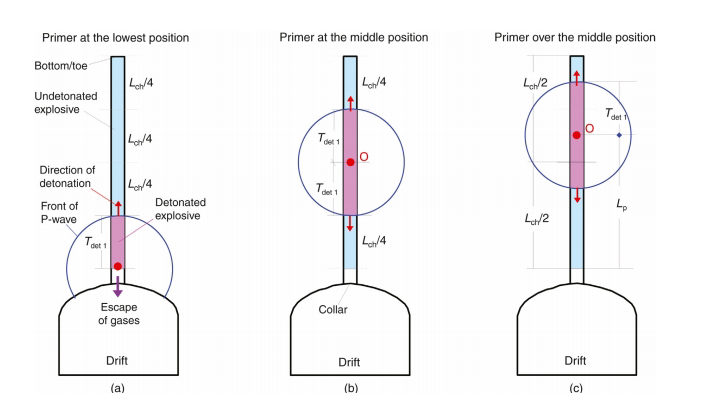
The primer charge Initiation is the giver of wave front direction and the dictator of how well the blast will go. When the primer is located at the 
Fig.1 shows an explanation of how the initiation of blast using three placement point. Fig.2 shows the wave front movement after initiation.
Fig.1: Placement view
Fig.2 Reaction after initiation
Fig. 3 Resulting Blast
From Fig.1, If only one primer is placed in a borehole, the primer can be placed at different positions. In order to simplify the analysis, we take three cases to discuss: (a) middle primer, (b) bottom primer, and (c) top primer In the case of two primer position: (a) two primers at the one-fourth and three-fourths length of the charge; (b) two primers, one at the bottom and the other at the middle; and (c) two primers, one at the bottom and the other at the top. Among these cases, case (a) is the best, case (c) is the worst and should be avoided, and case (b) is in between [6-7]. 
Conclusion:
Flyrock Generation is one of the hazardous product of blasting. It occurs when the Explosive energy is excessive and when the charge energy is excess at the hole collar. This can be as a result of using insufficient stemming length, less confinement, to small Burden and poor initiation system.
Understanding the behavior of wave Generated during initiation had been explained in this article. The article provide insight from published material, and gives recommendation on primer Placement and charge rate along blast hole collar.
The rock resistance reduced along weak zone and less burden region, when the Explosive charge increases, the breaking factor increases. In a case where excess energy is available, it is use for the throwing of rock particles, thereby causing damage to structures, building, human, and equipments.


References
1. Dick, R. A., Fletcher, L. R., & D'Andrea, D. V. (1983). Explosives and blasting procedures manual (No. 8925). US Department of the Interior, Bureau of Mines.
2. Meyer, R., Köhler, J., & Homburg, A. (2008). Explosives. John Wiley & Sons.
3.Taiwo, B. O., Hosseini, S., Fissha, Y., Adebayo, B., Adesida, P. A., Famobuwa, V., ... & Akinlabi, A. A. (2023). Safe small scale mine blasting operation: An application of soft computing techniques to predict blast-induced flyrock distance.
4. Zhang, Z. X. (2014). Effect of double-primer placement on rock fracture and ore recovery. International Journal of Rock Mechanics and Mining Sciences, 71, 208-216.
6. Morante, E. A. (1987). A primer on placement testing. New Directions for Community Colleges, 1987(59), 55-63.

Thursday, September 21, 2023

MISFIRE: IT'S CAUSES, CONTROL, HANDLING AND PRECAUTIONS

MISFIRE: IT'S CONTROL, HANDLING AND PRECAUTIONS
BY GIANT MINER
A FRESH GRADUATE STUDENT OF FEDERAL UNIVERSITY OF TECHNOLOGY AKURE, MINING ENGINEERING DEPARTMENT.

Buttressing all known definitions, Misfire is the incomplete or partial failure of a Blasting charge to detonate/explode as planned.I like to retorate  that, Misfire is not limited to charge failure at initiation, but also extend to accidental detonation of Explosive and other Blasting accessories.
modified after Australia mine
 Since misfire is a very hazardous, every reasonable means available to site manager must be taken to avoid it occurrence. 
Let Begin the journey by understanding how to recognize misfire;
After firing, a proper checking of face and muckpile must be done to ensure that there is no indication of misfire. The occurrence of misfire during Blasting result into the following blast challenges:
1. Production of Noxious (NOx gas) fumes and toxic dust,
 2. Inadequate ground movement,
3. Poor fragmentation,
4. Unusual blast sounds or vibration rate,
 5. Flyrock,
 6. Evidence of undetonated Explosive in bench face or in muckpile,
These are the Conditions a Blasting Engineer can use during blast to at least predict if there is misfire or not.
The occurrence of misfire (now during Blasting) is a bit dangerous but the post blast effect is the main problem.
How can this six (6) signs occur and why does it occurred?
Site Misfire Indicator
Production of Noxious fumes and toxic gases  is as a result of alteration in the Explosive oxygen balance due to incomplete detonation. As we all know, oxygen balance is very important.
It dictate the type of gas, time and dust produce from Explosive at detonation.
Each Explosive has been tested at production and all gases reacting with oxygen had been balance in such a way that, at detonation, only those gases that are not poisonous are released.
Incomplete or partial detonation of Explosive led to negative oxygen balance.
This final cause the complete production of Noxious fumes which is hazardous. This is a good indicator to identifying misfire from the generated gases from Blasting.
As a Blasting Engineer, it clear that Blasting 100 charge holes will generate more ground movement than 70 charge holes. As the charge density will be different. The production of less ground movement from large charge can be use as indicator of blast misfire.
Also, poor fragmentation result from misfire. During Blasting, failure of two or more holes affect burden movement. It create more oversize and poor fragmentation.
 post Blasting inspection of misfire
 Inspection of misfire after Blasting is a dangerous task. In all circumstances this must be done in accordance with site rules.
Hazard exist not only from the remaining undetonated Explosive but also from the post blast environment. Due to the present of toxic fumes. It is possible that misfire Explosive  detonates after some time, therefore it is essential that adequate trained personnel should regularly check the muckpile and face during loading operation. Unchecked misfire is very dangerous, when such is load and transport to the processing plant can detonate during crushing.
From various study by different researchers, there are four initiation stimuli that cause explosion Detonation, this is place under this acronyms:
FISH:
F: Friction, 
I: Impact, 
S: shock and
H: heat
The present of any of this four result in the initiation of Explosive.
 Impact during crushing can initiate undetonated Explosive in Boulder socket. 
PROCEDURE ACTION ON SITE
The extent and nature of misfire must be determined after identification. This must be done as soon as possible after the misfire has been identified.
After check and clear: The *All Clear* sign should be given.
But if not yet clear the dangerous zone must be barecad
 How to deal with identified misfire
Now after we have done our post Blasting inspection and confirm the occurrence of misfire. These are some ways to deal with identified misfire undetonated charge hole;
 A. Removing stemming and re-priming: These are some precautions to observe when removing the stemming materi.
1. When the detonator is close to the undetonated Explosive, stemming removing with force should not be attempt,
2.In case of electric detonator the use of high velocity air should not be attempted as it can generate static charges sufficient to initiate electric detonator
3. Bulk Explosive can be washed out of misfired shotholes.
4. special care must be taken in removing the cartridge expecially where detonators are involved
5. Under no circumstances should Explosives or detonator be removed from a drill hole by pulling on the detonating cord or detonator lead
6. Use suitable extracting tools if required.
Some of the advantage of using high pressure water to flush Explosive during misfire include;
1. It desensitise any non water proof Explosive and dissolve high concentration of water soluble Explosive ingredients
 2. It overcome the mechanical  lock of stemming material comprising chippings
 Other ways of dealing with misfire is by
B.Drilling and firing relieving holes:
The objective of drilling the relieving hole is to blast Explosive we are unable to remove. Also, to disturb and displace the adjacent Explosive column. Also, to break up the rock mass in the region of misfire explosive to remove undetonated Explosive. 
Precautions to be taken in drilling the relieving holes include;
1. The hole burden and spacing depend on the sensitivity of the Explosive, the inclination of the misfire hole and the diameter of the hole. 
2.The relieving hole must be parallel to the misfire hole and be of the Same depth.  
Relighting of a misfire safety fuse is highly prohibited and dangerous
Also, We should give enough time before going to the misfire site.
This is because the  blast charge can reinitiate with time. More than one hour is not even enough!
Also, charging when raining is prohibited and can cause misfire.
 Check Explosive before use, Blasting environment must be inspected before selection of Explosive. 
Use of non water proof Explosive in water log environment is bad. Because, as it has been damaged earlier, the Explosive material in it might have been deteriorated or infected which can lead to fire breakage at ignition.
CONTRIBUTION FROM ENGR. MOSHEN JENA
AEL Explosive and Blasting Engineer (Zimbabwe)
 Indications of a misfire
- Inadequate ground movement. 
- Undisturbed ground
- Lack of fracturing 
- Poor fragmentation in areas of shot
- Evidence of undetonated explosives
- Hang-ups on face
- Unusual blast sound
When you see that there is inadequate ground movement. obviously there is expected movement and when you see it falling short of what you expectected then there are high chances that there is a misfire
 Causes of Misfires
Technical failure
- Wrong primer/assembly
- Circuit connection/coupling fault
- Detonator/poor explosive coupling
- Unsuitable explosives
- Carelessness – damage to initiation systems
- Wrong equipment, e.g. exploder
- Equipment failure
   -Exploder (not serviced)
    -Circuit tester
    -Firing cables
Site conditions
Weak ground/movement
Water presence
Geological discontinuities – cut offs
Product failure
Detonating cord – gaps
Detonators – Faulty fuse head/delay
Shock tube – moisture ingress/connection block
Fuses – Moisture; poor crimping; damage
Explosives – water ingress; static pressure; decoupling

 Misfire implications (Safety)
-Unexploded explosives and or Unexploded initiation systems
-Unstable/sensitised explosives
- Accidental detonation
       -Drilling into misfires (no drilling into sockets)
       -Struck by LHDs
       -Run over by trucks/wheels
       -In crushers
       -On feeders/screens
-Deposited onto dumps
-Taken off site in tippers

*Re-entry into a misfired area*
   - Where the blast fired successfully all gases and dust must be allowed to clear before re-entry or   inspection.
- Where multi-blast conditions exist the following guidelines must be adhered to:
  A re-entry of 30minutes must be allowed after blasting.
  Where the initiator of the blast failed a re-entry period of 30 minutes must be allowed where      pyrotechnic systems are used and 5 minutes for electronics.
*Treatment of misfires*
Early shift examination
  -Mark the hole (MF).
   -Return the fuse, shock tube or downlines wire into the hole.
   -Plug the hole with a socket plug.
   - Barricade the area off with appropriate warning signs.
During the shift 
    -Remove the socket plug.
   -If ANFEX or Emulsion, flush hole with water.
    -If Cartridges, pull out with an approved scraper and wash out with water.
Remove cartridges and detonators in separate containers to old explosives boxes for destruction in a designated area.
Misfire Safety
- Never attempt to pull a misfire with force out of a hole or muckpile.
 - In the case of shock tube, the tube snap and shoot and the column charge can go off.
-In the case where the detonator is damaged to the extend that the explosives charges in the detonator are exposed, friction especially with grid in the hole, could cause accidental initiation.
-Always remember that detonators in a misfired hole have been exposed to extreme external forces  during the blast. This means that a detonator retrieved from a misfired hole is not in the state of the original manufacturing and could be potentially more sensitive.
*Reporting Misfires*
- Potentially the most hazardous situation to have to deal with is misfires.
*AVOID!!!!!!!*
Correct blast designs
Appropriate initiation systems
Always report misfires to the responsible Miner.
Always report misfires to the relieving shift.
 in parting let me share with you incidents that have happened elsewhere
 Remember, and *An accident is a total loss, unless we learn something from it*  A crusher attended was severely injured when undetonated explosives in the ore were hit by the crusher jaws resulting in accidental detonation of explosives. The injured was rushed to the hospital but died upon admission at the referral hospital. An LHD driver was luck to survive, after he was hit by flyrock ejected from accidental detonation when his bucket hit primed explosives whilst lashing. He sustained serious injuries but was saved by the screens on the LHD operators cab.
 A drill rig operator died after drilling into a misfire. The drill steel hit the misfired explosive and it went off. The operator sustained multiple fractures and the rig was also written off. We have deliberately removed the names of the mines so that we get learn from the incident without worrying about who did it. Whilst trying to pull a shock tube that had been reverse primed, there was accidental detonation. This resulted in a violent explosion that ripped the face of the charging assistant and he died instantly. An excavator hit a misfires and the explosion damaged the bucket of the excavator and shattered all the windows.
GIANT MINER General Conclusion
 Since to prevent risk which is the father of accident is greatly important, proper steps must be taken to curb any occurrence of misfire during Blasting. In addition, Explosive is a very dangerous chemical substance, is as good as proper handling, if out of hand can be highly disastrous. Furthermore, Handle all Explosive related operations with great care and consideration. Following all needful precautions and safety policy. 
Nigeria as a case study been a country with many large scaleime, small scale and artisanal mine need wide teachings and training about misfire. Most local blasters have less knowledge about this and had fall victim of such incident.
Make your country mine sector great by making it safe.
Thanks
Love you all

Still your GIANT MINER

Tuesday, September 20, 2022

MY HERO'S JOURNEY

My Hero's Journey

I use to be one of those youth who believe that life is all about fulfilling *your* dream, doing everything to ensure your life is better, study hard on your own, take time to explore and give less time to things of God.  As a first class student of Federal University of Technology Akure during my 200level days, I always give all my time to reading, all I see is just life and me.
I want to be the best, I want the best of life, I want to change my family storyline,get out of poverty trend and be a successful individual. *All of my heart desires were so cool and good but the factor of God first wasn't in my tent*
I built all my goals and occupied all the space, all I want is to live a successful life without the successful Creator Himself. I want Joy, but never submit to the joy Giver.
My fellow Corp members, I desire all good things just like you do right now,
I want stable finance, 
Good job
Happy home
Sufficient time with my work
I don't want to pray
I just believe the Bible is for some pastor kind of persons.
*But I was wrong!*
I thought I can make it by my strength but I was wrong!
I failed in my second semester year two.
What I was working to build was brought down once.
The first class grade
The finance
All left me despite the fact that I am committed to them, working hard and strongly.
But I found Him
My second phase of life begin after I found the truth about who Jesus Christ is and what had been paid and made available for me.
I was called out of darkness (Selfish mind set) into Christ. I heard about His birth, I was educated about His death on the cross, why He have to died on the cross and how. I was opened up to the perfect work of is resurrection and the implication.
I believe him, I recieved Him 
I welcomed Him in
I gave Him all
He restored back all to me and promised me all instead.
The greatest of all was that everything I always want to live outside of Him for, was given to me as an inheritance.
I get the best results, get a good job, have connections that network international relation with me.
Now I realize that all you want is in what you have. All you want is in Christ. When you Have Him, you have all.

Dear Friend, is your case like mine right now?
How to get the best of life?
How to stop living in sin, how to recieve eternal life that will give life to every dead works in your life?
Have you said yes to Jesus many times and still you can't see any changes?
Is sin still taking over you?

All you need is to surrender all..

Let go of all you hold on to...
Let Christ be at the center of all.....
I was once like that also, but I found Him, 
He Gave me a new heart, a new spirit and His Holy spirit according to His promise in Ezekiel 36:26-27.

"I will give you a new heart and put a new spirit in you; I will remove from you your heart of stone and give you a heart of flesh. And I will put my Spirit in you and move you to follow my decrees and be careful to keep my laws"

Now I have Joy overflow...

Make this decision now
Take this pray with your heart open and believe in your heart unto righteousness and Confess with your mouth now into salvation.

*Prayer*

Father, I am sorry for everything, I acknowledge that I indeed was wrong about life, I repent of all my sinful ways and thoughts.
Lord forgive me by your Mercy. I turn away from darkness into you marvelous light right now, because I believe in Your son Jesus, in who you have paid for all my debts. I receive eternal life now. Thank you Father for saving me.
Amen

Congratulations
If you have make this decision:
Please message me 
I have a good news for you (I like to know you and keep praying with you)
+2347031018600

Friday, June 24, 2022

AN OVERVIEW OF SURFACE MINE MAINTENANCE

THREE MAINTENANCE APPROACH FOR NIGERIA MINE IMPROVEMENT
INTRODUCTION
Maintenance of mine operation is important because of the need to monitor the earth response, see to the perfect working of mine plan and mine design.
Getting the Mineral extracted from the earth crust is the major reason for mining, but getting it in a safe and profitable means is the major goal.
Surface mining methods involved the extraction of shallow depth Mineral deposit through the complete removal of the overburden materials.
Developing the ore site and extracting the ore deposit using any of the previous explained methods follows stripping operation.
As the mining operation advances, the earth stress state and other redistributed forces impact the excavated region.
This will definitely require a preventative maintenance.
Below are some of the maintenance approach to ensuring a sustainable mining operation;
1. Maintenance of mine water: I understand from personal work study that Nigeria operates majorly surface mines, mostly quarrying and open pit methods. The creation of open cavity after mining provide a basin for water gathering. Such water if not properly maintained can accommodate dangerous animals, become dead trap for community people, support leaching at overflowing and also damage landscape through support flood action. 
Reclaiming mine out area with  treated mine waste or stripped materials will enhance the safety of abandoned mine area.
Major mine operations find less interest in reclamation process, abandoning the land after removing the content (mineral) is what most Company aimed at! 
This shouldn't be the case, the need for land coverage after mining is a good way of restoring the land to a useful state, Which makes it good for other purposes.
2. Mine design monitoring and adjustment: Most mine lack the ability to design and to implement the mine layout, this had led to untimely closure of quarries and mine in Nigeria and Ll around the world (especially Artisan mines and small scale mines). Putting proper design in place to account for the ground condition and current status of the environment is a good means of mine maintenance. Going by the saying that "Prevention is better than cure" preventing mine accident such as land slide, slope failure, misfire, flyrock among others is best achieved by proper design and implementation.
Mining Engineers and safety Engineers need to maintain the site design and supervise the implementation.
Below are some ways I discovered from Academia Research work and experience to maintain a typical mine slope:
1. Proper selection of bench height to avoid plan and wedge failure and other failure type,
2. Frequent checking of slope discountinuity property to avoid unnecessary movement and dislocation,
3. Proper selection of equipment to ensure good and safe working condition,
4. Proper control of mine water to avoid toe creeping and swelling,
5. Proper mine drainage system to avoid total closure or high dewatering cost,
6. Proper blast design and explosive usage to avoid blast illness ad over break,
7. Proper and accurate excavation, and
8. Frequent monitoring of Ground water and mine hydrological condition.
Maintenance of mine plan is vital to avoid unnecessary failure of mine slope, and mine closure
3.Mine Equipment maintenance: Though most Quarry operations in Nigeria and local mines in the world operate at small scale level with high level of manually perform operations. Yet, the use of equipment like excavator, payloader, crusher and the likes is inevitable. In order to ensure smooth operation in the mine, and to have a sustainable mine and environment, proper maintenance of mine equipment is very crucial. Checking from the perspective of generation of ozone layer depleting gases from poorly service heavy duty mine equipment,
Most mine lack the equipment preventive maintenance system. This result into poor production and contribution to unsustainable environment. Providing good preventive maintenance of mine equipment will not only improve mine productivity but also support sustainable environment.
Below are some suggested ways by which mine equipment can be maintained;
1. Daily check-up of equipment before work,
2. Periodic preventive maintenance,
3. Use of good condition fuel oil,
4. Proper and quick response of mine management to driver/maintenance team complaint,
5. Appointment of qualified mechanical engineer to ensure good equipment working condition,
6. Avoiding mine equipment over usage,
7. Avoid 24hours truck working without break,
8. Avoid using trucks beyond specified capacity, and many more
Conclusion
Starting the mine is not basically the problem but sustainable mine is usually challenging. Extraction of materials from the earth crust is important to human sustainability, likewise the safety of the environment and life's working in the mine and living around the mine. Maintenance of equipment, maintenance of the mine slope and operation safety is high imperative and crucial.
This will not only dictates the mine productivity but also it profitability.
Most mine get shut down quickly by surface and underground water simple because of lack of proper maintenance. Designing  good drainage and planing good water control system willo a long way to mine sustainability. Safety case when it comes to blasting is also another need to prepare for.
Blasting Operation demands full safety plan and preparation. Post blasting plan involves putting all things in place to ensure safe movement of Explosive material from magazine to the mine and proper distribution of material for each hole charging. Maintaining the magazine to avoid unwanted initiation or problem like self detonation under unfavorable heat conditions. The magazine maintenance must be such that it suit the storage condition of the explosive materials.
On site maintenance involves putting all needful in place to ensure safe use of Explosive and to avoid misfire and poor blast result. Blast ills such as ground vibration, flyrock, airblast, dust among others needs to be account for when planning the blast.
Finally, I support the safety of all mine operation, this will give hope to us and to our generation to come.
We mine to safe life and not to destroy it.
Thanks for reading
Writer
Taiwo Blessing Olamide
Giant Miner
Prospective student
Recommend me for your Research assistant
Looking forward to 
Join professor Research work 
Research interest: Rock excavation and Rick mechanics

Tuesday, June 14, 2022

Review of the Effect of Blast initiation Delay Timing on Blasting fragmentation

Review of the Effect of Blast initiation Delay Timing on Blasting fragmentation
By Taiwo Blessing Olamide 
GIANT MINER
INTRODUCTION
 Do you know that;
Explosive energy is higher when the shock energy supply for the initiation is high and accurate.
Also that, most mining operations uses inaccurate blast time and initiation timing. Two things affect Blasting efficiency appart from the blast parameters and rock properties.
 These are;
1. the initiation system and
2. the initiation approach. 
This article give a brief review on Professor Takis Katsabanis and Nikolaos Gkikizas-Lamptopoupos work.
Professor Takis is an explosive Engineer, lecturer in Queen's university Ontario, Canada.
Prof Takis of Queen's university Canada with one of His master's student Nicholaos Gkikizas worked on a project relating to this in 2016. The Thesis focus on examination of the effect of Time delay on fragmentation.
 The project was effectively experiments in the university Rock Excavation Laboratory under the full supervision of Prof. Takis Katsabanis. 
 The work involved two series of experiments.
First series involved tests on small scale grout and granite blocks to determine the moment of burden detachment. The instrument use for these experiments consist but not limited to strain gauge and Piezoelectric sensors, high speed camera. The result of the first series experiment shows that the time of rock particle detachment for the thesis set up is between 300 and 600 micro second. Meaning, as the Explosive shock wave fractures the rock and the gas energy perf
The major aim of blasting is to detach the rock into handable sizes, the important of studying the detachment time as indicated by Prof. Takis student was to ensure that the burden movement timing is accurately design between inter row and intra row drill holes. Each detachment time affect the fragmentation efficiency of the blasting. The major approach adopted in the thesis was to optimize the charge timing and get the detachment time right for efficient fragmentation.
The second series of the project involved blasting of a 2m high granite bench and it's purpose was to determine the hole to hole delay that will provide optimum fragmentation. Nicholaos Gkikizas worked reflect on this objective by adopting image analysis software for fragmentation efficiency examine for each delay observed. Also, he examine the produce vibration from the blast and also record the blast with high speed cameras such as Olympic i-SPEED 2 camera.
The result of the second series suggest that fragmentation was optimum when delays between 4-6 Ms were used for the experiment set up. It was also found that the moment at which gases first appear to be venting from the face was consistently around 6ms after detonation. In one of my blog article had take time to explain the concept of shock energy and gas energy release sequence during detonation. Nikolaos in his thesis indicated that the timing difference between the initiation period and gas explosion period was 6ms, this shows that from the initiation point to 5:59ms, the fracturing process was fully taking place. The crushing zone process, the tensile slabing process and the shearing.
The Research work of Prof. Takis Katsabanis student also shows that the mean fragmentation size changes with time delay. The experiment shows that the fragmentation mean size was higher at low delay timing and higher at timing greater than 8ms. Which shows that from 2ms to 8ms, the X50 is low with 8ms been the optimum delay second.
Nikolaos work also revealed that the delay timing affects the vibration level for the experiment conducted. Ground vibration is one of the most serious blast illness after flyrock. The energy distribution from explosive result into displacement of rock and earth crust material at a define frequency level. Such is also depending on the Maximum instantaneous charge per initiation. Prof. Takis student also shows that the shorter the delay timing the higher the possibility for overlaps (constructive wave interference) 6-8ms delay produces separation of pulses as indicated by the result from the vibration results.

Conclusion
This work had shown that the efficiency of blast production and safety also depends on the charge initiation and the timing allocation.
The productiveness of blasting Operation is the main aim and Target of blasting. Ensuring safety and profitability is also a great task. 
To ensure this is fulfil, there is a need for proper design and optimization of blast timing and design to achieve this great task.


Mining and safety is our main focus
Giant Miner is committed to safe mining and campaign against poor and unsafe mining. First in Nigeria and then to the whole world.
Share and comment
Reference
https://qspace.library.queensu.ca/handle/1974/15321

Sunday, May 22, 2022

Mining and Blasting operation: Learn Mining Operation 1

1. INTRODUCTION
Blasting operation is one of the mine operation begin communition process. It is define as the process of using energy generated through explosive detonation for rock mass fragmentation. In a simple definition, I explain mining engineering to be a profession that provide needed mineral resources through application of safe technology. Mining related with the earth crust in a safe approach to release the naturally deposited mineral resources for human use. Mining Field surely make sense and can't be look down on because of the need for Innovation and technological development in manufacturing companies. The world currently have enough space ships, aircraft, cars, motorcycles and many heavy equipment that demands high supply of metals and fuel minerals. Currently, we consumed more salt, uses more cement produce from limestone, clay, iron ore, gypsum, human being keep constructing more roads with asphalt produced from the mixture of bitumen and granite dust. Infact, more quest to diversify energy source from electricity to solar energy had keep the need for glass sand and other light metals demand high. Mining is one of the field that supports the growth and development of any Nation. Not just to supply raw materials but also add value to the National economy. This article focus on providing ground explanation about Blasting operation productivity and safety. This content mentioned several materials use for blasting; why blasting can be dangerous and what makes blasting beautiful and safe. The main aim of this article is to provide individual with information to get the know more about the advantage of mining and also teach the reader one of the way by which we mining engineer go about liberating the mineral from the earth crust.
2. Explosive and Blasting operation
Firstly, I will like to give a simple definition of blasting to be the use of industrial explosive in an industrial way for rock fragmentation.  Explosive by definition according to Dick and Fetcher is any chemical compound capable of undergoing rapid or violent detonation under the influence of a stimuli or impulse such as heat, lightening, fire, impact, friction or shock. And upon such detonation it releases energetic gas and wave sufficient in magnitude to explode/destroy any form of obstacles barricading it pathway. The Mineral as refer to in mining and geology field is an accumulation of element coming to form a solid substance that is crystalline and has a define chemical composition e.g Gold, mica, calcite. This minerals existing in various form and their chemical composition makes the difference between the various available categories. Each equipment, tool, materials existing on Earth is known to be a product of mineral or agricultural product. These minerals are formed through the cooling process of emolten magma during igneous rock origination. These minerals are distribute within rock mass In different quantity (assay), the amount of each Mineral in a rock mass define the function and usefulness of the rock itself. 

2.1 Duty of a mining Engineer
The duty of mining Engineer is to make design for the extraction of this minerals (ore deposit) from the earth crust. Mining life cycles define the stages of mining operation, it begining from Prospecting to exploration, then to exploitation, and finally to reclamation. Each of this stages depends on o e another. The main stage where the extraction work begin is known as the Exploitation stage. This stage begins after all the deposit overburden had been strip and all needed equipment have deployed to the mine. Exploitation stage in mining consist of development, drilling, blasting, loading, and haulage process.
The stage initiate the extraction process of mineral from the earth crust through the use of different equipment and machineries. As mentioned by Tiile, 2016, mining is a capital intensive operation due to the required operation cost to develop the deposit, extract the deposit and transport the mineral run-off-mine from mine-to-mill. Study hhas also revealed that blasting operation account for about 10-15% of the total cost of mining operation due to the need to provide drill holes at define design on the rock bearing Mineral, provide explosive and explosive  and Blasting accessories materials. 
This article is therefore important for both blasting professional and upcoming mining and civil engineers in order to provide them with basic knowledge about blasting influence on mining productivity and also sensitize them on the need to get blasting right.
3. Blasting factors and design control
The need to fragment rock mass and get the insitu rock broken into smaller sizers had always been the reason for blasting since the beginning of Mining. Scholars work on Blasting had proved that blasting operation is controlled by two basic factors, these factors are identified to be the controllable and the uncontrollable optimization of blasting is important to control mine downstream operation and reduce dilution rate from the site. Getting ride of both external and internal dilution in Mineral operation is important and needs special attention. Not only to reduce transportation cost but also to minimize the total ore dressing cost.
Blasting design involve taking the right decision about the controllable factors to ensure good utilization of Explosive energy for rock fracturing. The controllable factors include but not limited to burden, spacing, hole diameter, hole length, charging length, powder factor among others. These factors are adjustable from the blasters end to ensure explosive quantity is optimize for blast per ton. 
Most research work towards the effect of burden and spacing on blasting efficiency had proven high impact due to the fact that this parameters not only control the energy utilization and efficiency during blasting, but also determine the Explosive energy distribution within the rock mass grain. When burden is increased, the load on explosive per ton increases and this will definitely result in poor fragmentation and possibly tangential vertical flyrock projection.
Most blasting operation performed by ASM consider nothing about the design and striking balance between the controllable factors and uncontrollable factors. The only focus had always been to get the ore by all means. Making money is not all to Mining, mining profession is to mine for life sustainability and not destructiveness.
4. What Small scale mining Companies need to Do to improve their blasting operation
The small scale miners are refer to as those who extract Mineral deposit with local tools and basically at small scale level. 
This mining sector tends to go after placer deposit, unconsolidated Mineral bearing formation using local tools and small Operation machines. Some of the mining methods used by ASM includes, placer mining, leaching, quarrying, looting, panning to mention few.
As small scale miners, this group of people also perform blasting with ANFO, dynogel and many other emulsion explosive products.
To improve ASM blasting operation the following needs to be put in place by the management,
1. Appoint a professional and experience mining Engineer to see to the mining operation supervision
2. Provide a good operation plan for the mine
3. Provide a blasting team head by a good experience blaster/Explosive Engineer
4. Provide good training and handbook for all the blast team members
5. Have a selected day, time for blasting in your mine. The selected time and day must be well known to all mine workers
6. Refrain from illegal buying, storage and transport of explosive
7. Training all blasting team about interpretation and implementation of blast plan
8. Provide an active blasting supervisor who sees to the affairs of the blasting team members
9. Provide a good communication Iink between the blasting team and the management
10. Do not dictate or try to deviate from provided blasting plan materials requirements basically for profit margin
11. Device a means for pre-design of all blast before site operation
12. Provide safety team and after blast checking team (2-5 skillful individuals)
13. Create awareness to all workers about Blasting days and signs
14. Management should be sensitive and active to blasting team need
15. Provide all needed PPE
16. Provide blasting do and donts as a list 
17. Define safety zone or blasting muster point I'm the mine usually at some kilometers from the blasting zone
18. Check all explosive before using
19. Return all unused explosive accessories to the magazine, do not keep in the ware house or take it home   (Big danger).
20. Stop transporting explosive with bike and putting detonator with the Explosive when trainspotting. STOP!!!
21. And many more
Conclusion
Mining is mining when is done with safety first. Blasting without safety first is a bomb blast which is incongruous to the environment. 
All our Targets must be to improve the environment handed over to us and not to damage it.
NIGERIA as a whole, African miners and mining engineer all over the world should give full attention to ASM Operations and help them in various ways such as in design and professional advice.
If ASM failed fly, Large scale mining will not survive, not the world will recover from various lost of insufficient raw materials.
Blasting is for peace and not for war
Explosive is not kolanut or sweet, stop hiding it in your room and store house, take it to the magazine.
Long live Mining

Monday, March 21, 2022

EXPLOSIVE USAGE OPTIMIZATION USING AIR BAG

Brief on Blasting Design
Blasting operation is one of the most important operation, looking from the capital influence on operation cost, the important of Blasting result on downstream operations and the place of safety. Most mine and quarries are not sensitive enough to understand the principle of Blasting operation and it significant in mine profit margin, because all Blasting is Blasting to them provided the ore ore industrial rock mass is broken down.
Some of the blast design by operators in common quarries around Africa and others continent where small scale miners and Artisanal miners dominate are extremely poor and give low Explosive Energy ultilization.
It has been proved by many research that poor blast Design with lack of agreement between the blast parameters like burden, spacing, stemming length, subdrill among others will definitely produce poor fragmentation with high environmental illness such as ground vibration, airblast, noise, flyrock among others.
Giant Africa mines expecially Nigeria mines like Dangote, BUA, Freedom Quarries, Fanalou Quarries, Geo-works Quarries, Stoneworks Quarries among others are making great different compare to other local Quarries handled by ASM. This Giant mines have great mine plans and design that help them in striking balance between the hypertensive parameters.
But nevertheless, most of them still under use Explosive energy and still haven't balance the variance effect between the controllable factors (burden, spacing,hole diameter, Stemming, e.t.c) and the uncontrollable factors (rock strength, discontinuity nature of rock mass, chemical property of rock among others).
Blasting operation is capital intensive as I had earlier explained in one of my published write up, the Effect of poor Blasting is not restricted to just loading and transportation but also stretch wings to downstream operations like crushing, grinding and Separation because libration begins from Blasting as Explosive energy not only break rock but also weaken the intermolecular bonds in rock grains.
Previous years ago I meant one of the giant blasterman in Akoko Edo local government of Edo state Nigeria, I was quest to ask him why using ANFO as the column charge and the reason for using it in abundant?
He replied as with this that, ANFO is a strength breaker Explosive, thou it is a low Explosive or better still Blasting agent, it assist and sustain High Explosive energy within the rock mass and ensure it saturate and weaken rock strength. This will reduce work on the processing machine by aiding easy comminution process.
Why air decking is likely going to yeild result that Stemming material decking!!!
Many never sieze from asking me this question concerning the reason why I think air decking will give better Blasting than solid material decking.
Talking about decking in Blasting operation we refer to the situation where innert material is place within explosive charge to reduce charge delay and also produce diversifer stand for the explosive wave.
At the point of detonation, explosive charge initiate generate fast waves which travels at a speed greater than the speed of sound in more than Seven times (>2100m/s), the wave energy perform the Major function of microfracturing (Slabbing). At the point of initiation, the waves are released to complete propagation after getting to the free face. The use of air decking (air bag) definitely provides closer free face medium for the shock waves which makes it reflects back quickly to support the lateral waves after longitudinal wave collision. In other words, the resulting wave generate from the air bag after collision support the rate of fracturing beyond the crushing zone. This support increase in fragmentation and proper breakage of the rock mass.
It also help to provide higher confining which gives the charge more avenue to release more explosion gas for casting and fragmenting.
In conclusion, Air bag help in the reduction of explosive charge weight per blast, reduce the maximum instantaneous charge per delay which directly minimize the blasting operation cost.
It also support good fragmentation; this advantage is important since theain aim of blasting is to get sufficient Run-off-mine at low cost for profitable production.
Also, good fragmentation assist in the minimizing of dilution and challenge of unexpected increase in transportation cost from mime2mill.
Finally, safety has always been the watch word and first thing on the dial of mining industry. It is of no doubt that blasting is one of the most dangerous operation in mining operation cycle due to the high energy involved. Such energy as that release form explosive can be destructive if not safely utilize and can be devastating if poor use. The use of Air bag is one of the cheapest way to ensure the safe and profitable use of explosive.
Remember, Mining the ore safe is better than mining it profitably when the mining act and condition is unsafe. Ensure bis safe and profitable to avoid any for of accident which is the end product of hazard. Eradicating principal hazard to avoid principal threatening condition works like magic for those mining industries that put all mining safe and profitable strategy in place.
Maje safety first.
Thanks and Happy mining


Friday, February 11, 2022

ASM Needs help with safety

Blow out and flyrock is one of the evidence of poor and unprofessional blasting operation.
This can result from poor steaming and overloading of holes and sometimes result from low charge weight.
Energy is define as the ability to get the job done, the capacity to overcome the energy barrier.
There are many ways to generate energy but for rock breaking, the use of explosive had been the most adopted means since 1900s. In every proper work done, professionalism is very important. Lack of professionalism result into disaster and accident. Since the aim of mining is to promote safety first through new innovation, inventories and safety management system, then the call for help to ensure this is achieve in Artisanal and small scale mines is important.
Fact
The artisanal miners will keep existing in the stope of mining operation as they has always be because if the following reasons:
1. challenge of start up capital in developing countries to set up large scale mine
2. large scale mines will for sure always go for huge deposit, neglecting placer/alluvial deposit with low grade and non uniformly distributed. #mining 
Artisanal miners need assistance and help to ensure all operations are safely carried out.
Reason for urgent response
The approach adopted by the low income Miner to extract alluvial formation tends to affects the environment, damage water, land and even air through pollution and acid mine drainage.
Aside from this hazardous effect, small scale mining operations working with insitu hard and soft rock sometimes engage in drilling and blasting operation.
This operation in most ASM mines are performed with less consideration to safety. Getting the explosive charge quantity that will break the rock down safely without any environmental effect becomes important. likewise understanding the behavior of this explosive generated shock and gas energy also contribute to ensuring the Earth crust condition after blast remain stable and safe for human existence.
Th question now arise that who will sensitize the ASM and other quarry workers about the safe design and execution of blasting in Most Africa and less developed country.
Explosive is for peace and not war
Let get the across to the ASM operators about the best and safe usage and handling of explosive but during transportation, storage and usage.
the mission is to go for safety first!
As all the mining worker must return back home to enjoy nice dinner with their family.
blasting aim to support innovation, development, and human existence beautification.
mine the ore safely
get the ore peacefully
support peaceful and safe mining
#campaign_Against_unsafe_Blasting
 #environment #safety #drilling #africa #innovation 

Wednesday, February 9, 2022

Blast it safe to safe your world

Brief Summary
We must be alive to get all the money we are dreaming and thinking about! Mining still remains the most lucrative business in the world with high impact on Technology Development.
But the level of safety at the blasting operation cycle is minimal due to lack of sensitivity despite millions of Research work on this area.
This article was put together By Taiwo Blessing Olamide to sensitize the World mining sectors on the need to get involved in small scale mining to avoid unforeseen disaster.
What blasting may look like if picture from a perspective
Check below picture to have a view of what blasting is and what quantum physic can be involved in getting the rock fragmented
instantanous casting of fragments from overloaded blasting
Article
Looking are many developed countries it becomes clearer that they are all functioning well in their large scale mines. Likewise the developing countries, they tends to have some level of success in the record of medium scale mining operations.
Taking a look at the small scale mining operations as a case study Nigeria and other Africa countries, most mining operations in artisanal and small mines are poorly monitored and design. Professional Mining engineers are kind of Given up on the local miner, instead of any form of assistance they set their compass on the direction where large mining thrives. Less attention has given to help, improve and monitored small mining operations because the large scale miners have all Earth equipment to get their mine cleaned and discretely planned.
This become my view and concern! That, though the small scale mining operators are abundoned but with time the large scale mines will soon fold up, reach the ultimate limit and come back to the small scale sites. In addition, the small scale miners might later cause damage to the Earth and bring aftereffect implication on the large scale mines and human existence at large.
Small mining firms are known for less safety concerns, less safety management and supervision.
looking from the direction of Blasting, small scale miners are not much concern about the effect of flyrock and it's causes, better worth how to minimize it.
They are less concerned about the effect of timing on blast fragmentation (Appreciating Professor Takis findings at Queen's University). This sectors are less aware about the aftermath effect of generated shock waves from excessive powder factor, how it can over break the wall, damage the unmined rock mass and reduce the stability of the mine slope completely.
Though we have our own mine safe and try not to show concern for the poor miner, neither do we have any plan to train, sensitize them on what they don't know. Before we try to mine for our own profit and mine development alone is time to begin a sustainable mining that check out others operation to avoid the future damage which is possible of affecting our mother Earth.
The ground itself has a stable stress field before the disturbance team called miner came, the induce stress resulting from excavation is capable of shifting all stress equilibrium into stress instability if proper control is not put in place. Each tectonic plate has it own respond to all the generated dynamic waves. But a time shall come when the plate will no longer be accommodative, then what can be done?
prevention is better than cure!
say no to poor blasting
support through mentorship, surveillance and supervision all blasting
manager must now be concern about the report of all blasting, not just how much tonnage do we get but how safe was the blast.
safety first
Before Fire in the Hole, Safety must be assured
Mine is safe
Blast it safe
Check!! Check!! And recheck before putting fire

Friday, February 4, 2022

The beauty of a Good blasting is safety: Go for safety to safe the world

        Sir Dyno Nobel
The rock Mass contain the ore mineral which is the mining engineer major target. Mineral resources are inevitable material needed for Technological innovation and national development. The place of this mineral resources can not be suschanged neither can it be replaced with synthetic materials.
By definition, I describe mineral as solid inorganic naturally occurring matter, that is been generated during magma eruption through sufficient time cooling and interrelate and exchange of element in the liquified rock lava.
The mining engineer as well known by other disciplines involve themselves in getting the ore from the Earth crust and refining it to fit end user's need.
The extraction process begin from altering the Earth land form through wide range of excavation and degredation attempt to get the so called overburden material removed in order to gain access to the enriched ore vein.
Emphasis on Bowen series reaction*: During formation of mineral, the cooling time tenders to affect the location of each precious mineral, some tend to form at deep depth due to the slow rate of cooling. Slow cooling support fast  and bigger growth of mineral size. The bigger the mineral accommodation, the higher the economic value. This condition makes the ore deposit locate in strategic position where need arise for size reduction to ensure the valuable minerals are easily separated.
Ore is an accumulation of valuable mineral existing in an economic quantity. This ore is what the Mining engineers want and it existence can only be found in rock Mass. In addition, the ore block do not exist alone as an entity but usually bond with the parent rock which can be igneous, sedimentary or metamorphic rock.
The host rock may exist as outcrop or deep depth rock Mass which becomes impossible to move directly to the processing plant for libration and separation process.The quest bring about ways to reduce the rock mass and free the ore block for further ore dressing. Transportation of run-off-mine is capital expensive and also the mine-to-mill operation cost is high!
Innovation attempt in the 1900s to begin the use of black powder aim to assist and improve mining operations.
This improvement covers the production and cost minimisation.
Likewise the 1960s Innovation of detonation cords and cap by the Dyno Nobel group assist the safety and effective use of the energetic material.
Blasting Is important but must be safely carry out to ensure the reason for blasting is not been blasted.
Let your manager be aware!!!!
Campaign against unsafe Blasting
Say no to poor and unsafe blasting operation.
Both civil works and mining operations required blasting activities to get the rock Mass size reduced or get the obstructing rock casted out from the road map.
Using explosive in a bit to generate the needed energy can be highly dangerous if not properly handled 
Many quarries had begin blasting long year ago without any plan, without any post blast check, without any preblast planing. Fire work is not good when out of hand and this can happen when excessive powder factor is use or there is existence of misfire due to unforeseen circumstances.
Blasting is much more dangerous and must be done safely.
This campaign is to sensitize all quarry owner, manger and mining engineer on the need to put proper consideration on proper and safe blasting.
Advice to mining industry:Things to enhance your blast safety
1.Get the blast design right
2. Conduct your preblast checking and take note of various structural features that needs design attention
3. Identify any hole with fractures and note any existing dyke and sills as intrusion
4. Supervise the handling and transportation of all explosive material from magazine to site and from site back to the magazine
5. Monitor all explosive usage and ensure due procedure is follow during charging and chaining to avoid unnecessary fire cut, misfire and other arising issue with blast impulse distribution.
6. Provide good policy for you blasting team and monitor all unsafe act and conditions with instant action
7. Give all blasting operation special team for emergency response and safety team.
8. Ensure all clear surveillance is made available and active for all blast operation.

Let make blasting a good blasting and not a Killing or ground damaging blasting.
We want the ore for the people, then we must not create dead trap for the people through landslide, wall fall and holing due to over break during blasting.
The explosive energy is for peace and not for war
#campaign_against_unsafe_blasting
#GiantMiner

Stay Safe from COVID19 and stay Secured, Corona Virus is Real!!!

  Chronological Development of Fragmentation Analysis Methods Over the decades, fragmentation analysis models have evolved significantly, dr...

Learn on this